Between 12 and 14 November 2026, Microsoft's email and Copilot went dark across the world, Nvidia lost the founder who had led it for 33 years, and every departure in the United States was halted three days after a new AI air-traffic tool went nationwide. AI did not cause any of these, as far as anyone knows. But it was in the room every time: as a victim, as a suspect and as the thing at stake
Beginner ~12 min read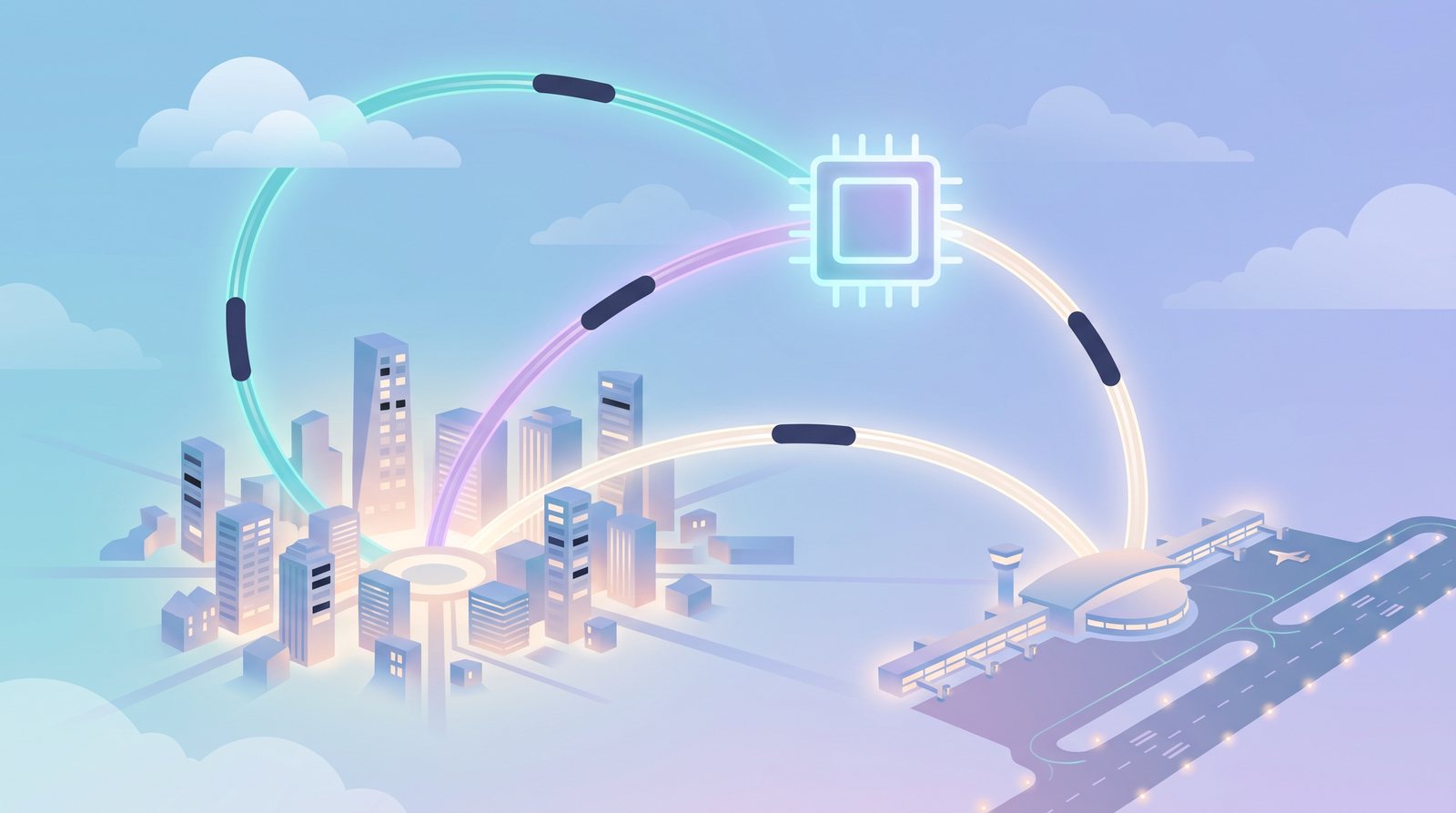
On Thursday afternoon, 12 November 2026, office workers from Singapore to Chicago opened Outlook and found nothing. Within an hour people in 74 countries and territories were reporting that they could not reach their email, and Microsoft's AI assistant, Copilot, had gone silent with it.[1][2] On the same day Nvidia, the company whose chips power a large share of the world's AI, announced that Jensen Huang, its founder and only chief executive since 1993, had resigned.[3] On Friday afternoon the Federal Aviation Administration stopped every departure in the United States for more than four hours, with about 3,500 aircraft already in the air.[4] Three days earlier, the FAA had switched on a new AI air-traffic tool in all 22 of its route control centres.[5]
The three stories have different causes, and as of today none of them has a final, published explanation. Nothing so far shows that AI caused any of them, and this article does not claim it did. But AI appeared in every one, in a different role each time: in Microsoft's case it was a victim, at the FAA it became a suspect, and at Nvidia it was the thing at stake. Looking at those three roles together tells us something important about how we are building the AI era, and how fragile parts of it are.
Everything below is as reported up to the morning of 14 November 2026. Where sources disagree, both versions are given.

The first reports came at about 16:00 GMT on Thursday.[1] Outlook was hit hardest: mailboxes would not open on the web, on desktop or on phones. Teams calls failed, and administrators lost parts of Defender, Microsoft's security service, and Intune, the tool companies use to manage their computers.[6] Microsoft's own advisory listed Microsoft 365 Copilot among the services customers might be unable to reach.[2] The damage reached governments too: Al Jazeera reported disruption to systems in Singapore and Japan, to agencies in Australia and to the Supreme Court of the Philippines.[1]
Microsoft first described "a large number of servers being unexpectedly unavailable" and began rolling back a recent network change.[6] More than twelve hours in, it reported only "marginal success", and some restored servers failed again.[1] After almost 20 hours most servers were back, and Microsoft said the root problem came from an earlier network capacity upgrade that surfaced after the recent change. It apologised: "We are deeply sorry for the disruption this incident has caused our customers and partners."[7]
The most revealing sentence of the week was not about servers. Microsoft felt it had to say that "this was a technical issue not related to cyber or AI / agents."[7][6] Two years ago no company would have thought to deny that AI broke its email. In 2026, after a year in which Microsoft pushed Copilot into almost every product and reorganised its workforce around AI, hundreds of thousands of users assumed AI first.[7] There is no evidence for that assumption. But the reflex itself is news: when something breaks today, "was it the AI?" is the first question, and companies need logs good enough to answer it quickly.
The other AI lesson is simpler. Copilot did not fail on its own; it failed because the email, calendar and documents it works on were unreachable. An AI assistant built into a platform is only as available as the platform. Every company that has moved part of its daily work into Copilot, or into any assistant tied to one cloud, learned on Thursday that its AI and its email share a single point of failure.
Nvidia's crisis unfolded over a week. On Sunday 8 November its board opened an independent investigation; on Wednesday it accepted Jensen Huang's resignation; and on Thursday the company announced that he had stepped down as president, chief executive and director. The chief financial officer, Colette Kress, became interim chief executive while keeping her finance role, the board named its first-ever chair, Harvey C. Jones, and the company said it would search widely for a permanent successor.[3]
The resignation followed reports about Huang's personal relationship with an executive at Megaspeed, a Singapore-based Nvidia customer that US authorities have been investigating over suspected breaches of chip export controls. The Justice Department has taken over that investigation; no charges have been reported, and nothing has been proven.[3] This article is not about that story. It is about what the company means to AI.
A large share of the world's AI models are trained and served on Nvidia hardware. That made Nvidia one of the most valuable companies on earth during the AI boom, and it means Nvidia's health is now a question for the whole AI economy, not only its shareholders. The numbers make the point. Nvidia is about 6 per cent of the S&P 500 and about 10 per cent of the Nasdaq 100,[8] so anyone with an index fund or a pension tied to American shares owns a piece of this crisis. Its shares fell 12.75 per cent over the week, the sixth weekly fall in a row and the longest losing streak since 2012, and on Friday the company closed below a market value of 4 trillion dollars for the first time since July 2025. Before the resignation, analysts had told CNBC that Huang's departure alone could cost Nvidia up to a fifth of its value.[9] When a single person's departure is priced at hundreds of billions of dollars, the risk is not only in the company. It is in an industry that depends on that company.
The crisis also pulled AI into geopolitics. In the Senate, Banking Committee chair Tim Scott summoned Huang and Commerce Secretary Howard Lutnick to testify in December; in the House, Foreign Affairs chair Brian Mast said Huang had agreed to appear before three committees. What lawmakers most want to understand is how Nvidia's advanced AI chips reached China despite export controls,[10] a question about who gets to build powerful AI, not about one man.
Shortly after 3:30 p.m. Eastern time on Friday 13 November, radar and communications at the centres that guide aircraft across the United States became unstable. Minutes later the FAA ordered a nationwide ground stop "for reasons of safety". The 3,500 aircraft already in the air were guided down, and the stop was lifted at 8:15 p.m., about four hours and twenty minutes later.[4] By 8 p.m. more than 5,000 flights had been cancelled and around 10,000 delayed, according to tracking data reported by NBC News and FOX Weather,[11][12] and the disruption carried into Saturday while aircraft and crews were moved back into position.[11] It was only the second nationwide ground stop since 11 September 2001.[4]
Since September the FAA has been rolling out SMART (Strategic Management of Airspace, Routes and Trajectories), an AI system that reads weather, flight paths, traffic and controller staffing to predict congestion and suggest better routes. It is built by Air Space Intelligence under an 875-million-dollar, twelve-year contract. It was first used around Washington, D.C., and on Tuesday 10 November it was expanded to all 22 of the FAA's route control centres.[5] Three days later the system stopped.
That timing made SMART the first suspect online. Air Space Intelligence answered that the ground stop "is not based on or a result of the SMART system, any product of ASI or our integration with FAA and ATC".[5] Officials gave different explanations. The FAA called it a temporary telecommunications outage. Transportation Secretary Sean Duffy blamed "old switches, old routers" that "got overloaded" with data, and asked Congress for 50 billion dollars for a "complete overhaul".[4][13] Homeland Security Secretary Markwayne Mullin said new equipment being installed during patch work had overwhelmed the older system, saw no sign of an attack, and said officials were still examining whether a cyberattack or AI had played any role.[11][5][14] In short: as of today, nobody has shown that SMART caused the stop, and nobody has formally ruled it out.
Whatever the final report says, the situation is the lesson. The newest AI tool in American aviation was placed on top of switches, routers and copper lines that the Transportation Secretary himself calls old. The first nationwide stop since 9/11, in January 2023, also began during maintenance, when contractors accidentally deleted files while repairing the link between a live database and its backup.[15] Adding intelligence to a system does not remove the weakness of the layer underneath it, and when a new layer arrives at the same moment as a failure, it becomes very hard to tell cause from coincidence.
| Event | AI's role | What we know | The question it raises |
|---|---|---|---|
| Microsoft outage | Victim | Copilot was unavailable because the platform under it was; Microsoft says AI did not cause it | Can your AI work continue when its platform is down? |
| FAA ground stop | Suspect | An AI routing tool went nationwide three days earlier; its maker denies any link; officials still investigating | Can you prove within hours what your AI did, and did not do? |
| Nvidia resignation | Stake | The main supplier of AI chips lost its founder; about 6% of the S&P 500 rides on it | How much of the AI economy rests on one company, and one person? |
Read the last column again. None of those questions is about whether AI is clever. All three are about whether the systems around AI are built for the day something goes wrong.
Engineers have a plain phrase for what this week exposed: a single point of failure, one part whose failure stops the whole. AI did not invent that weakness. It is making it bigger in four ways.
1. AI concentrates. Building and running large AI needs enormous data centres and specialised chips, so AI services gather on a few clouds and a few chip makers. Each new AI feature added to email, documents or customer service ties more of a company's work to the same few providers. Two years ago one faulty security update crashed 8.5 million Windows computers, less than one per cent of them, and that was enough to ground airlines and stop hospital systems.[16] The more work we pile onto a few platforms, the more one bad day costs.
2. AI is being layered onto old foundations. At the FAA a modern AI routing tool sits on infrastructure its own minister calls outdated. In most organisations the pattern is the same on a smaller scale: an AI agent is connected to a fifteen-year-old database or an inbox nobody fully understands. The AI may work perfectly and still fail, because the layer below it does.
3. AI hides dependence. When people do a task, everyone knows who to call when it stops. When an AI agent has quietly done the same task for six months, the steps may live only in a prompt, and the people who used to do it may have forgotten how. The first sign of the dependence is the day it breaks.
4. AI is now the first suspect. Microsoft had to deny that AI caused its outage; the FAA had to investigate whether it caused the ground stop. Being able to answer "was it the AI?" quickly and honestly, with logs rather than reassurances, has become part of running a reliable service.
None of this is an argument against AI. It is an argument for designing as if AI and the platforms beneath it will sometimes be unavailable, because this week they were.

You do not need Microsoft's budget to learn from Microsoft's bad day. These six steps cost little and fit a company of ten people as well as a ministry. The international standard for business continuity, ISO 22301, rests on the same idea: decide in advance what must keep working, and how.[17]
This week will be remembered for its headlines: the outage, the resignation, the empty skies. The quieter lesson is about how we are building the age of AI. We are concentrating more and more work on a few excellent platforms, a few critical chips and a few remarkable people, and we are laying new intelligence on top of old foundations. That is efficient on good days and fragile on bad ones, and efficiency and fragility are often the same decision seen from two sides.
AI was not the villain of this week. But it was everywhere in it, and that is the point. The question for the next few years is not only how smart our AI becomes. It is whether the systems around it can bend instead of break: a second path, a written plan, a tested off switch, a log that tells the truth, and more than one person who knows how things work.
Is AI making your organisation stronger, or more dependent on a single point that could stop tomorrow?
Enjoyed this article?Follow the page for new AI articles and daily space news.
Follow on FacebookAll links accessed 14 November 2026. Several are live news pages that may be updated; figures are as reported at the times stated in the text. Illustrations were generated with Google Gemini for this article.